

ENOJP4 Hildesheim 2018
Chair: Jan Gerrit Strala
Panel 1: Nishida and Political Philosophy
How to Mix a Cosmopolitan: Reading the “individual” in Nishida with Karatani
Jan Strassheim (Keio University)
Abstract: Contemporary Japanese philosopher and literary critic Karatani Kōjin takes an ambivalent attitude to Nishida Kitarō. On the one hand, he sharply (sometimes polemically) criticized Nishida’s intellectual stance under the militarist regime. On the other hand, Karatani’s philosophy contains clear – but oten implicit – echoes of Nishida, whom he credited as an early proponent of deconstructivist thought. his attitude, I would like to suggest, relects an ambivalence in Nishida’s writing. From his 1911 Inquiry into the Good onwards, Nishida relates the individual to a universal community of mankind transcending statehood. Nevertheless, he increasingly ascribes a key role to the state as an intermediary between these two poles. An individual is always a member of a generality, he argues; conversely, a generality determines itself in the form of individuals. Generality thus holds a central position which Nishida ills with the state, or, depending on the context, with a variety of social formations such as nation, culture, tradition, or community. he individual as such is by necessity “mediated” by such formations which, given their
entral position, lend themselves to naturalizing tendencies in terms of race or a family- state. his tension between (a) an emphasis on social formations and (b) a universalism which transcends these formations could be related to an ambivalence in the notion of “individual”. Karatani, in his 2001 book Transcritique, draws a distinction between two pairs of concepts: 1 The first pair is “particular” (tokushu, 特殊 ) and “general” (ippan, 一般 ). his pair forms the basis of Hegel’s argument that the individual is always a particular case of general ideas which ind their expression in the State. 2. Karatani ofers another pair of concepts he inds in Kierkegaard: “singular” (tandoku, 単独 ) / “universal” (fuhen, 普遍 ). Viewed through this lens, individuality has the meaning of a singularity escaping all general determinations, including those in terms of statehood. Individuality in this sense correlates with the dimension of a universal which transcends statehood in the opposite direction. In its singularity, the individual is “cosmopolitan”: it encounters other individuals in the open and transitory “field” of the universal. While Karatani does not mention Nishida in Transcritique, his distinction might be used to disentangle two similar dimensions of the “individual” – as either singular or particular – in Nishida (who refers both to Hegel and to Kierkegaard). he context of Nishida’s philosophy would then suggest treating the “singular” dimension as the primary one. he opposition of singularity and universality is not mediated by a concrete community, but it unfolds in the “space between communities” (Karatani). Viewed from within the narrower circuit of the particular and the general, both the singular and the universal appear as “nothing”. At the same time, the wider circuit of the singular and the universal contains within itself all concrete possibilities of particularization and generalization. his would support a “cosmopolitan” reading of Nishida which would speak against recent attempts in the political arena to re-emphasize closed boundaries of states, cultures or ethnicities.
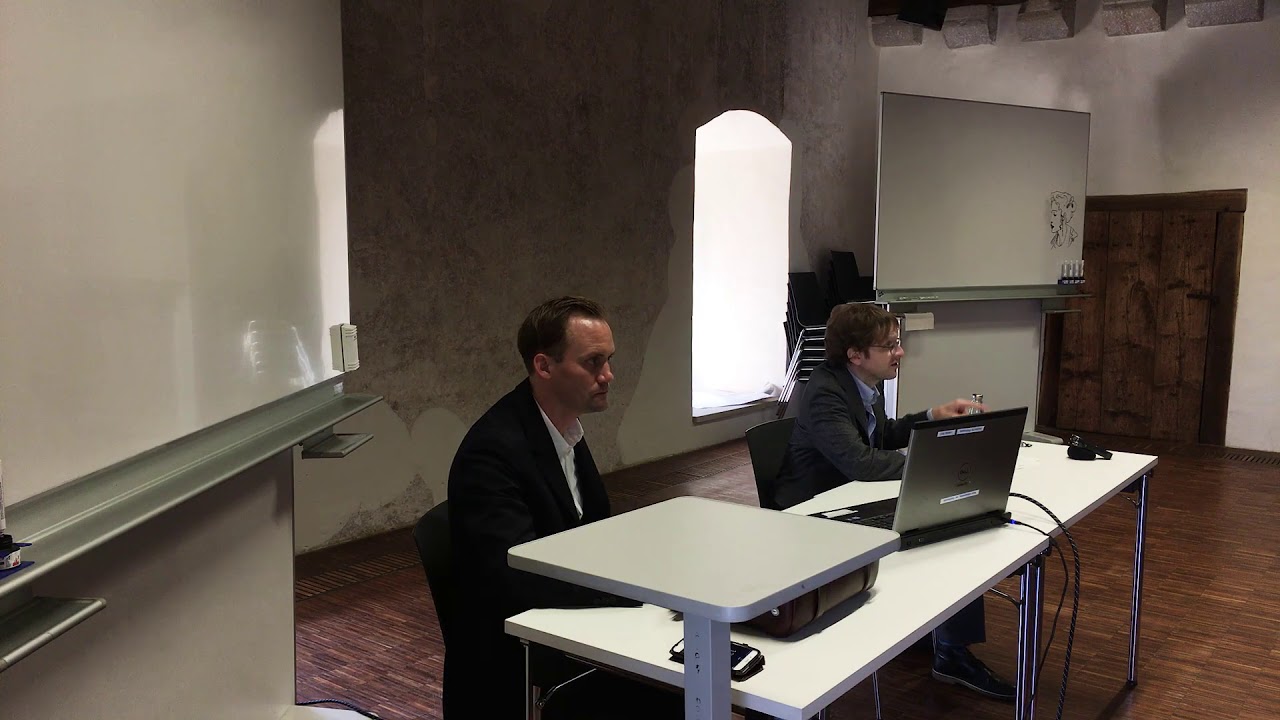
This talk took place at the Second annual conference of the European Network of Japanese Philosophy [ENOJP], 5 – 8 September 2018, Universität Hildesheim, Kulturcampus Domäne Marienburg, Germany.
More informations:
Art Direction: Robin Alberding & Jerome Ebeling (CC-BY 3.0)


0 Comments